

|
Getting your Trinity Audio player ready...
|
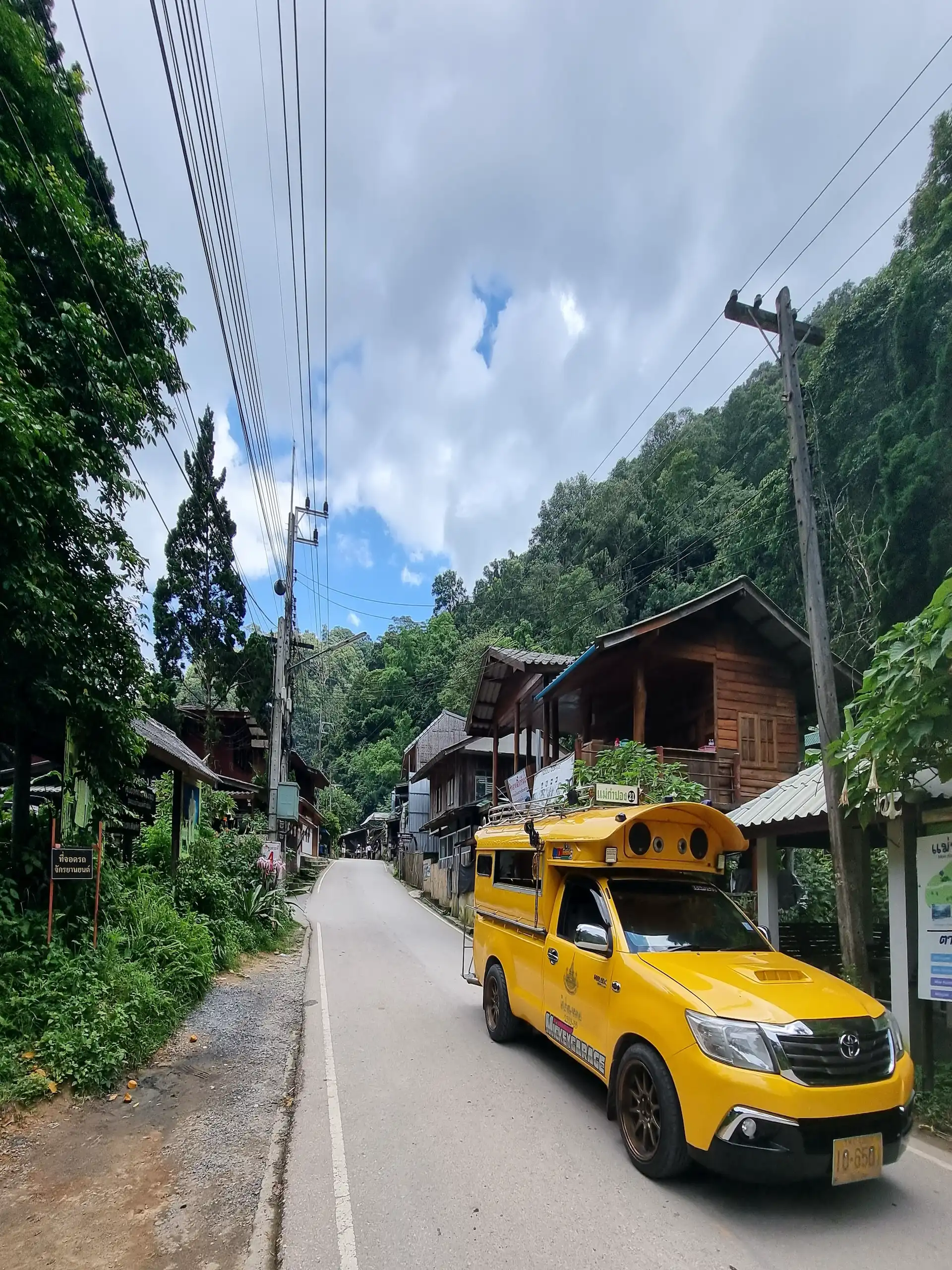
If you spend more than a few minutes in Chiang Mai, you’ll notice pickup trucks with bench seats everywhere. These vehicles are songthaews, one of the most common ways locals and visitors get around the city and surrounding areas. A songthaew is a converted pickup truck with two bench seats in the back. The word literally means “two rows,” which describes the seating layout. In Chiang Mai, songthaews function as shared taxis and informal public transport rather than large pulic buses.
Table of Contents
- Why the Colors Matter
- Red Songthaews: Getting Around the City
- How to Hail a Red Songthaew
- Other Colors: Fixed-Route Songthaews
- What Each Color Generally Means
- How to Get a Fixed-Route Songthaew
- A Simple Way to Remember It
- Like it. Pin it.

Why the Colors Matter
At first, I only took the red ones. They were easy to find. I would stop one, say where I was going, and get in. The driver would nod or shake his head, and that was that. After a few days, I started paying closer attention to the street around me.
Then I began to notice other colors driving past at the same times each day. I saw yellow, green, white, and orange trucks, and many of them seemed to follow the same paths. They were not stopping as often, and they did not slow down for every person on the side of the road. So I asked a driver about it. He told me that some songthaews have fixed routes. The color is a simple way to tell where they are going. Once I understood that, the whole system made more sense.
Red Songthaews: Getting Around the City
Red songthaews, often called rod daeng, are the most common. They move through the city without fixed routes. Instead, they circle busy areas like the Old City, Nimmanhaemin, the Night Bazaar, and the airport. They pick up people who are going in the same general direction.
Prices are usually low and paid per person at the end of the ride. Short trips near the Old City often cost about 20 to 30 baht. Most rides in the city fall between 30 and 40 baht. Longer trips, or rides where you are the only passenger, can cost closer to 100 baht.
Do not get upset if a driver shakes his head, says no, or gives you the dreaded Asian X. He is not being rude. He may already have passengers going another way, or he may be heading to a specific area.

How to Hail a Red Songthaew
Hailing a red songthaew is straightforward. Stand on the side of the road going in your direction and stick out your arm as one approaches. The driver will stop and ask where you’re going. It definitely helps to name a well‑known landmark such as a gate, market, mall, or temple.
If the driver nods or quotes a price you’re comfortable with, you get in the back. If they shake their head, it usually means they are full or not heading that way. Another songthaew typically comes along within minutes. To get off, press the buzzer inside the back of the truck. Payment is made directly to the driver when you exit.
Other Colors: Fixed‑Route Songthaews
White, yellow, green, blue, and orange songthaews operate differently from the red ones. These usually run on semi fixed routes outside central Chiang Mai. Many of them start from the bus station and head out to nearby towns and neighborhoods. Locals use them every day to get to work, school, and home.
Fares for these route-based songthaews are cheaper and more predictable. Most rides cost between 20 and 50 baht, depending on distance. The price follows the route, so there is no need to negotiate.

What Each Color Generally Means
Each color usually corresponds to a direction. White songthaews head east toward areas like Sankampaeng. Yellow songthaews run north toward Mae Rim. Green songthaews travel northeast toward Mae Jo. Blue songthaews head south toward Lamphun and Saraphi.
How to Get a Fixed‑Route Songthaew
Fixed‑route songthaews usually start from transport hubs rather than roaming the city. Warorot Market, also known as Kad Luang, is one of the main starting points. To use one, go to the hub, find the correct color heading in your direction, and quickly confirm your destination with the driver. Pointing and saying the place name is usually enough. Pulling it up on your phone is even better. Most songthaews stop along a route like a bus. Just press the buzzer when you want to get off.

A Simple Way to Remember It
I took my first ride on a songthaew to the entrance of the Monk’s Trail or Wat Pha Lat. I went by myself, there and back. That small trip gave me the confidence to keep using them.
Songthaews, along with apps like Grab, Bolt, and InDrive, give you more freedom around the city. With songthaews, you need to agree on the price before you get in. The other colors follow set routes, cost less, and locals use them every day, but it is still smart to confirm the price ahead of time.
There are other ways to get around, including taxis, tuk-tuks, and motorbike taxis, but I kept coming back to songthaews. They were easy, affordable, and always close by. Once I understood how they worked, the city opened up in a different way. Getting around felt simple, and I stopped thinking about it so much.
Like it. Pin it.


I love sharing stories, lessons from abroad, and tips for curious travelers. If my work has inspired you or made you smile, please buy me a coffee. Your support helps me keep the blog running—at no cost to you.
My articles are available as mobile apps for offline reading and GPS-assisted directions.
Download my articles on GPSMyCity.
This post contains sponsored and/or affiliate links, and I may earn a small commission.
Discover more from Duffel Bag Spouse Travels
Subscribe to get the latest posts sent to your email.