

|
Getting your Trinity Audio player ready...
|
Most seniors travel without knowing how many protections federal law gives them. Airlines rarely explain these rules or the services they must provide when asked. Because of that, many older travelers move through airports with more stress and uncertainty than they should. This guide explains the airline rights for senior travelers that matter most, including the Air Carrier Access Act. These rules exist to support your comfort, safety, and dignity every time you fly.
Table of Contents
View Table of Contents
- Hidden Senior Fares
- TSA Cares: Personal Help Through Security
- Seating Accommodations Under Federal Law
- Meet-and-Assist Escort From Gate to Gate
- Free Medical Bags
- Modified TSA Screening for Travelers 75+
- Guaranteed Pre-Boarding
- Priority During Cancellations
- Tarmac Delay Rights
- Requesting a Complaint Resolution Official

Hidden Senior Fares
Airline rights for senior travelers help older passengers move through airports with less stress. Some airlines still offer senior discounts—but they hide them. You won’t find these fares online, and they won’t volunteer the info. If you’re 65 or older, you have to call and ask. Say this:
“Can you check for a senior fare for a passenger over 65 on this route?”
That one sentence can save you real money on domestic and international flights. If you don’t ask, you pay full price. Period.
TSA Cares: Personal Help Through Security
Understanding airline rights for senior travelers can make long travel days easier. Security lines are chaos for everyone, but seniors have an option most never use TSA Cares. It’s free, and it gives you a dedicated agent to walk you through the checkpoint, help with bins, and explain every step. Mobility issues? Medical devices? Anxiety? Memory concerns? TSA Cares is for you.
Here’s how to get it: call the Passenger Support number at least 72 hours before your flight. When you arrive, say something simple like: “I use a walker and need assistance,” or “I get anxious in crowds and need help.”
In addition, you are allowed to wear hearing aids and cochlear implants through security, as they typically do not alarm metal detectors. Before walking through, simply inform the TSA officer that you are wearing hearing devices. You can request the service by calling the number listed at passenger support at least 72 hours before your flight.

Seating Accommodations Under Federal Law
The Air Carrier Access Act isn’t just legal jargon—it’s your ticket to a more comfortable flight. The Air Carrier Access Act makes flying easier for travelers with medical/ disability needs. Airlines must provide certain seating accommodations at no extra cost—these aren’t upgrades, even if they’re usually sold at a premium. Examples include aisle seats for easier access, bulkhead seats for extra legroom, and adjacent seats for personal care attendants.
If you live with arthritis, fused joints, neuropathy, balance issues, or chronic pain, these rights are yours. Here’s the magic phrase:
“I require an aisle seat due to a medical condition,” or “My leg cannot bend, and I need a bulkhead seat as a disability accommodation.”
Say it clearly. These words activate federal protections. No begging, no extra fee —just claiming what the law guarantees.

Meet-and-Assist Escort From Gate to Gate
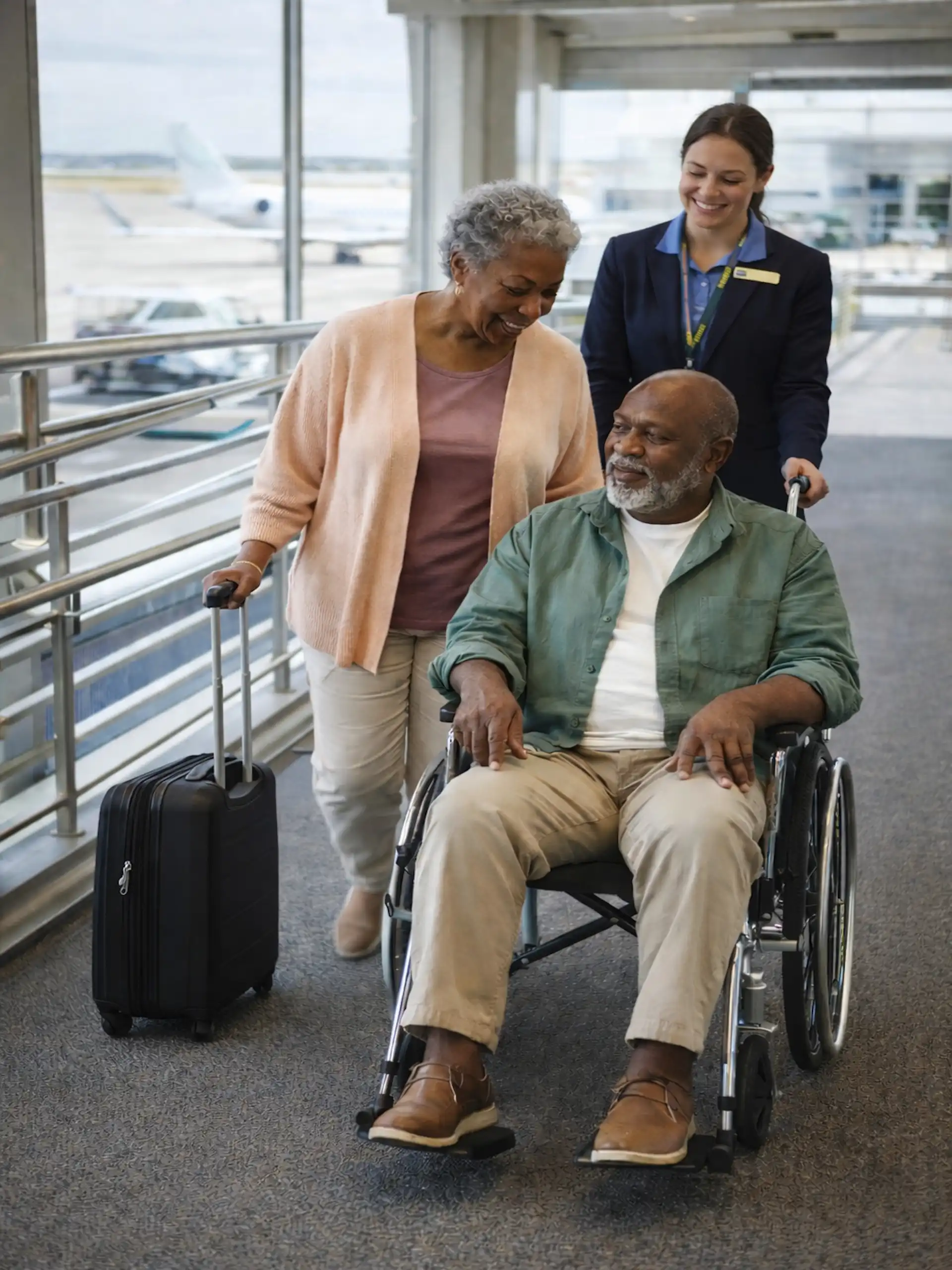
Airlines are required—by law—to give you guided help through the airport if you need it. This isn’t a favor; it’s a service that starts at check-in and continues through security, boarding, and the walk to your seat. When you land, the escort meets you at the aircraft door and takes you to baggage claim or your next gate. Check out the Air Carrier Access Act Disability Guidance for more information.
Why use it? Limited stamina, trouble walking long distances, cognitive concerns, or just feeling overwhelmed by crowded terminals. If you move slower or need extra support, this is for you.
Here’s what you say:
“I need guided assistance due to a mobility impairment.”
That one sentence triggers the airline’s obligation to arrange it. No excuses, no extra fees—just the help you deserve.
If you prefer not to disclose your specific ailments, wear the hidden disabilities lanyard or TSA Notification Card (available in the airport). The Sunflower Lanyard is a globally recognized symbol for hidden disabilities, discreetly signaling to airport staff that you might need more time or clearer instructions. You can also use a TSA notification card to privately inform officers about medical conditions or implants.
Free Medical Bags
If you travel with medical devices or prescription supplies, you don’t pay baggage fees for that bag—period. It’s the law. Agents may question you, but don’t back down. Say:
“I am traveling with medical equipment that is exempt from baggage fees,” or
“This is a medically prescribed assistive device.”
This bag doesn’t count toward your regular allowance and is exempt from standard carry-on limits. It covers medications, CPAPs, insulin pumps, and other essential devices. Pack your device in its own labeled case, free of other items, and clearly declare it as medically necessary and exempt to staff.
The standard 3-1-1 rule for liquids does not apply to medically necessary liquids, allowing you to bring larger quantities. For ice packs used to keep medication cold, ensure they are frozen solid at the checkpoint to avoid them being treated as a liquid.

Modified TSA Screening for Travelers 75+
TSA allows travelers 75 and older to keep their shoes and light jackets on during screening. This policy helps reduce falls and discomfort. If a pat-down is needed, you can ask to be seated for stability. Details are available on the TSA Security Screening page.
Some travelers do not know they qualify because the airport signage is small. If you are traveling with a parent or older relative, knowing this rule can make the day easier for them. You can simply state the traveler’s age and ask for modified screening. You can also ask for a chair if they feel unsteady during the process. Just say something like:
“The traveler is over 75 and qualifies for modified screening.
Guaranteed Pre-Boarding
The Air Carrier Access Act requires airlines to offer pre-boarding to travelers who need extra time. This includes many seniors, especially those with reduced stamina, limited vision, balance concerns, medical equipment, or discomfort in crowded spaces. You do not need a diagnosis or paperwork. You only need to self-identify at the gate.
Pre-boarding allows you to walk down the jet bridge at your own pace and settle into your seat before the aisle fills. This reduces stress and lowers the risk of falls or being rushed. It is especially helpful for seniors, people recovering from surgery, and anyone who needs more time to move safely. You can say, “I would like to request pre-boarding because I need extra time to get to my seat and get settled.” If the agent hesitates, you can ask that the request be honored under the Air Carrier Access Act.
Priority During Cancellations
Federal rules require airlines to give travelers with medical needs priority during long delays and cancellations. This includes earlier rebooking, hotel vouchers during overnight delays caused by the airline, and help arranging meals or transportation. These protections fall under the Air Carrier Access Act and DOT consumer rules.
This rule helps anyone who cannot stand in long lines or wait for hours without support. You can say, “I am a passenger with documented medical needs, and this delay creates a hardship. I need priority rebooking and information on accommodations.” This helps protect your safety and well-being during unpredictable situations.
Newlaking Adjustable Door Stopper and Jammer
Hotel Door Jammer/ Locks for Travelers Safety Locker. Secure your space with the Newlaking Adjustable Door Stopper and Jammer. Its adjustable design fits most doors, providing reliable protection against forced entry. Lightweight and portable, it’s perfect for travel, dorms, or home use. Crafted with durable materials, it’s easy to install without tools, offering versatile safety wherever needed.

Tarmac Delay Rights
TSA allows travelers 75 and older to keep their shoes and light jackets on during screening. This policy helps reduce falls and discomfort. If a pat-down is needed, you can ask to be seated for stability. Details are available on the TSA Security Screening page.
These rights matter for everyone, especially travelers who take medication with food or who cannot sit for long periods without discomfort. You can ask for water or a snack to take medication if you need it. You can also ask the crew when they plan to meet the DOT requirements if the delay continues.
Requesting a Complaint Resolution Official
If an airline denies a valid disability-related request, you can ask for a Complaint Resolution Official. Every airline must have one on duty or available by phone. This official is trained in the Air Carrier Access Act and has the authority to step in when you face resistance. Details are available through the U.S. Department of Transportation’s Air Carrier Access Act disability guidance.
You can say, “You are denying me an accommodation under the Air Carrier Access Act, and I need to speak with a Complaint Resolution Official.” This usually leads to a solution because airlines must follow the procedures laid out in federal law. If the issue continues after travel, you can file a complaint with the Department of Transportation, and the airline must respond in writing within 60 days.
Like it. Pin it.


I love sharing stories, lessons from abroad, and tips for curious travelers. If my work has inspired you or made you smile, please buy me a coffee. Your support helps me keep the blog running—at no cost to you.
My articles are available as mobile apps for offline reading and GPS-assisted directions.
Download my articles on GPSMyCity.
This post contains sponsored and/or affiliate links, and I may earn a small commission.
Discover more from Duffel Bag Spouse Travels
Subscribe to get the latest posts sent to your email.