
|
Getting your Trinity Audio player ready...
|
I went to the Sistine Chapel alone. The night before, the hotel manager leaned across the desk and gave me some good advice. He told me to go early so I could be there when the doors opened. His tone was serious, not dramatic. I understood that he was offering more than a tip. He was giving me a strategy.
The next morning, I was the fourth person in line. I beelined my way through the Vatican Museums, passing long corridors and empty galleries until I reached the Sistine Chapel. When I stepped inside the chapel, only a few guards stood along the walls. The space felt larger than I expected and quieter than I imagined.
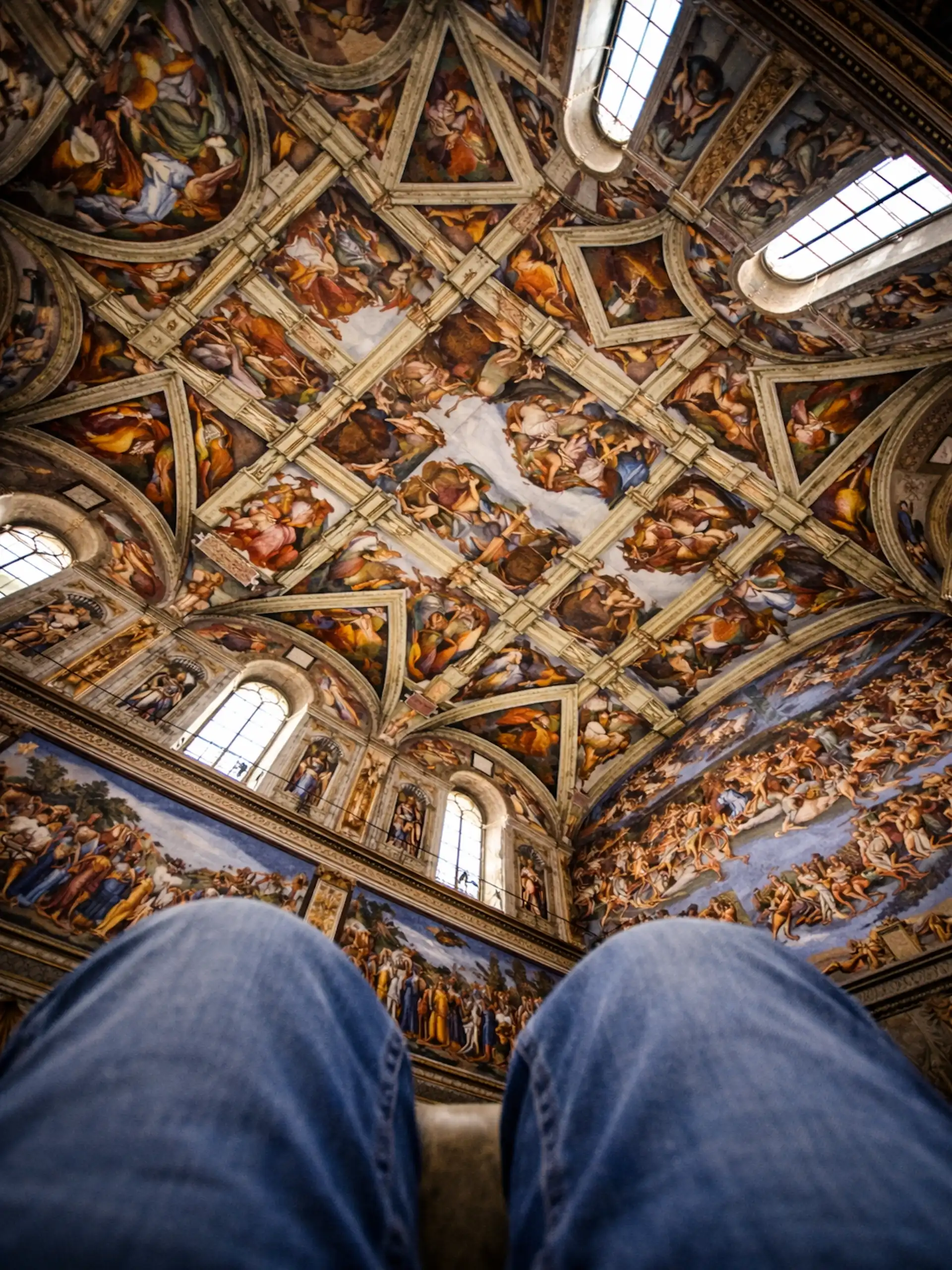
There were a few signs that said be silent and no photographs. I was heartbroken. Looking around, I found a wooden bench and laid down flat on my back. No one even stopped me from taking a few pictures. For twenty full minutes, I stared at the ceiling before another visitor entered the room. I could hear my own breathing. I could feel the weight of the space above me.
Table of Contents

The Sisteine Chapel was a Commission Michelangelo Never Wanted
In 1508, Pope Julius II ordered Michelangelo to paint the chapel ceiling. Michelangelo was known primarily as a sculptor, and he did not hide his frustration. He believed rivals had encouraged the Pope to give him an impossible task so they could watch him fail.
The ceiling rose nearly 20 meters above the marble floor and covered more than 500 square meters of blank plaster. Instead of relying on a team of painters, Michelangelo dismissed most of his assistants. He designed his own scaffolding and climbed upward to begin the work himself.
For four years, he painted standing upright with his arms raised above his head. Paint dripped into his eyes. His neck stiffened so severely that he later wrote about his physical strain in letters and poems. The Pope frequently climbed the scaffolding and pressed him for progress. Michelangelo’s answer remained steady. He would finish when he was finished.
As I lay on the bench, I tried to imagine that tension. I pictured wet plaster, arguments, exhaustion, and stubborn pride filling the same space where I rested quietly centuries later.

Looking Up at Creation
The ceiling of the Sistine Chapel holds more than 300 figures arranged across nine central scenes from Genesis. Painted architecture frames the stories, creating the illusion of depth and structure. At the center, Creation of Adam captures the moment just before contact. God’s hand reaches toward Adam, and the narrow gap between their fingers carries enormous emotional weight.
From the floor, the bodies appear alive. Both the men and women sported muscular bodies. Drapery folds naturally over shoulders and hips. Faces show tension, curiosity, and fear. The scale feels overwhelming, yet the details remain precise.
Because the room was nearly empty, I could let my eyes wander slowly. I did not have to compete with raised phones or whispered tours. The silence allowed the ceiling to feel less like a monument and more like a silent conversation. between me and the painter.

The Walls of the Sistine Chapel
More than two decades later, Michelangelo returned to the Sistine Chapel to paint The Last Judgment on the wall behind the altar. He was in his sixties when he began the work, and the tone had shifted. The figures twist and strain as angels pull souls upward and demons drag others downward. The composition feels urgent and unsettled.
In the center of the chaos, Michelangelo painted himself. He placed his own face on a flayed skin held by Saint Bartholomew. The expression appears tired and exposed. It does not celebrate triumph. It suggests vulnerability.
When a cardinal criticized the nudity in the painting, Michelangelo responded through his art. He portrayed the critic among the damned, complete with donkey ears. The gesture revealed both his temper and his wit.
Years later, Michelangelo became chief architect of St. Peter’s Basilica. In his seventies, he designed the dome that now defines Rome’s skyline. He refused payment for the work, saying he did it for the love of God.

Twenty Minutes of Stillness
As more visitors entered the Sistine Chapel, the sound shifted. Footsteps scraped across the marble floor. Whispers rose even though the guards kept repeating, “Silenzio.” In a few minutes, the room lost its quiet and turned into a current of movement.
Those first twenty minutes were different. I laid flat on the bench and let my eyes move across the ceiling slowly. I thought about resistance and responsibility. Then I thought about a man who did not want the assignment that made him immortal. I kept circling the idea that the work we resist sometimes becomes the work that defines us.
I tried to imagine craning my neck for four years while painting. Why? Because I laid there for twenty minutes and carried the ache the rest of the day.When I finally sat up, my neck throbbed from staring at the ceiling for so long. I took one last look before stepping away. The corridor outside had filled. After I saw what I had come for, I slowed down and wandered through the rest of the Vatican Museums.
The Gallery of Maps pulled me in. Painted coastlines stretched across the walls, slightly wrong but wildly confident. Borders drifted where they should not. I stopped in front of the horse-that-isn’t-a-horse. It looks more like a large dog. The artist had likely never seen a real horse. You can tell. The proportions are off. The legs do not quite hold the weight. That mistake makes it more interesting. It reminds me that history keeps shifting because the people shaping it work with limited knowledge.
Final Thoughts
By the time I reached the exit, the hallways roared. Groups pressed shoulder to shoulder. The chapel had likely filled wall to wall by then.
First, go early. Not because it sounds efficient, but because quiet changes everything. When I returned a few years later at a more comfortable hour, the feeling was gone. Silence is not guaranteed there. You have to earn it with an early alarm.
Second, move with intention. I did not linger in every gallery on the way in. I walked straight to the chapel and saved the wandering for later. That choice gave me space before the tour groups arrived. You can always circle back. You cannot rewind an empty room.
Third, let yourself be still once you are inside. Sit down. Stay longer than feels polite. Look up until your neck aches a little. That bench gave me twenty minutes I did not have to share. In a place built for crowds, that private pause became the real gift.
Google Pin: https://maps.app.goo.gl/VSC9Xty1iEoXkBgF6
Like it. Pin it.


I love sharing stories, lessons from abroad, and tips for curious travelers. If my work has inspired you or made you smile, please buy me a coffee. Your support helps me keep the blog running—at no cost to you.
My articles are available as mobile apps for offline reading and GPS-assisted directions.
Download my articles on GPSMyCity.
This post contains sponsored and/or affiliate links, and I may earn a small commission.
Discover more from Duffel Bag Spouse Travels
Subscribe to get the latest posts sent to your email.
I always found it very fascinating that Asians would show the peace sign in all photos. Nowadays I think it’s quiet cute and so ‘Asian’ 🙂
It’s also very popular in India. I don’t know how it got so popular. Even I used it when I was younger (in school). I don’t do that now.
I know, that seems to be the same everywhere. No one knows where it came from, it just started one day and took off from there.
What an Interesting topic, peace sign are used for a years and we use it peace sign in the church said that peace be with you.
Hahah, The peace sign has been used for years! We actually use it in church to give peace to our friends and famiy members that are not close.
Haha thanks for sharing.
Before I was able to explain that it actually is a “v” for victory, not a peace sign. But what does it really mean, and when did it start? I wasn’t able to give an explanation. So, I thought I’d do a little research on the topic.
I’ve always wondered about the peace sign too, I just thought it was just something that they have culturally done for a long time. It’s interesting to know a little bit of the history.
This is very interesting I never noticed before how many asian countries used the peace sign. I used to use the peace sign a lot when I was younger,but rarely use it anymore.
http://prettyfitfoodie.com/2017/04/23/plan-the-perfect-night-of-wine-painting-at-pinots-palette/